
The Need to Take Personal Responsibility for Your Financial Health
The economic climate, both nationally and globally, is having significant negative effects on standards of living. Inflation, personal debt, lack of savings, job insecurity and other factors are impacting how, and to what degree, people are supporting themselves and their families.
These things are also affecting people’s future well-being – what their standards of living will be in their retirement years.
Many people depend on Social Security, but the program has been projected to become insolvent by 2035, or sooner. And the political will to solve the problem is currently not present. Even if Social Security continues on, it will not provide sufficient benefits for most people to live comfortably.
________________________________
With all its alluring promise that someone else will guarantee for a rainy day, Social Security can never replace the program that man’s future welfare is, after all, a matter of individual responsibility.
— Harold Stonier, former Vice President of American Bankers Association
________________________________
The news is just as bad, if not worse, for employer-sponsored retirement plans. People with these pension plans are likely to receive much lower payments than they anticipate … at a time in their lives when they need them the most.
And what about self-funded pensions, like IRAs and 401(k) plans? The performance of these plans depends largely on the investing savvy of those who own them; and Americans, as a whole, aren’t especially shrewd investors. Plus, many people who have access to these plans choose not to participate in them.
Also, longer life spans, more active retirements, and the rising costs of goods and services make it important, now more than ever, for people to take personal responsibility for their own financial affairs – to save and invest and to put in place plans that will prevent them from having to depend on others.
Unfortunately, many people do not feel that they can save and invest for the future, because they are just barely paying today’s bills. They hope to begin saving when they begin earning more.
But often, it comes down to the old-fashioned virtues of determination and discipline. Our goal is to help you to see that you can, indeed, begin – even now – to take some important steps toward financial security and independence.
The Value of Precious Metals
When it comes to investing, traditional investments are stocks, bonds and cash (or cash equivalents, like money market funds and CDs).
Alternative investments are things like real estate, commodities and collectibles. These kinds of investments can be more risky than traditional investments, but the advantages of owning them outweigh the disadvantages.
Of all the alternative investments, real estate and precious metals (particularly gold and silver) are the most popular. And in recent years, the demand for gold and silver has increased significantly.
We believe that precious metals can play an important role in creating and preserving wealth.
There are several strong reasons for owning precious metals.
- Precious metals provide an effective means of diversifying an investment portfolio. Experts have recommended that approximately 10% to 20% of an investor’s assets be devoted to tangible assets such as gold and silver.
- The metals themselves have intrinsic value – unlike a piece of paper that says that you own stock in a company. Their value will never be zero.
- Precious metals have almost universal appeal. Everyone loves gold and silver.
- Precious metals are not a renewable resource, so there is a rapidly diminishing supply.
- Gold and silver can provide a potentially substantial retirement fund – income that will supplement whatever other income you will have when you retire.
- Precious metals are a hedge against inflation, which is the loss of the purchasing power of currency. Inflation increases the price of goods and services – and decreases the value of the dollar. That is why a dollar today will not buy what it would in the past. But precious metals usually increase along with inflation, so inflation does not reduce their value. That is why an ounce of gold today can still buy essentially what it would in the past.
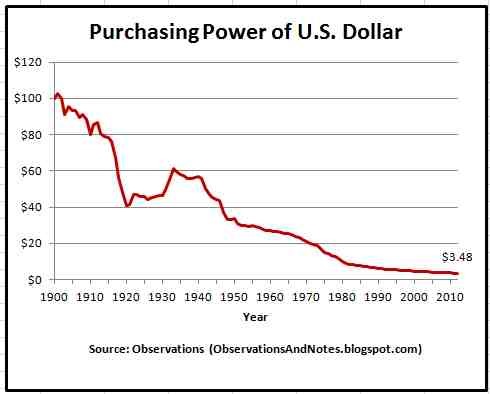
The U.S. dollar has been losing its value for many years, and chances are good that its devaluation will continue. One of the best ways of protecting ourselves against the weakness of the dollar is to own assets that have intrinsic value around the world. Precious metals have a proven record of holding their value. They offset the effects of the devaluation of the dollar and create a better opportunity to create wealth.
Precious metals can help to create and protect financial wealth, stability and independence – even during economically challenging times.
The Silver Bullet
Of all the precious metals, silver is especially good to own.
Like gold, silver has been used as money for a very long time, but silver has more practical uses than gold or other precious metals. It is used more heavily in both industrial and medical applications due to its versatility and unique chemical properties. Consequently, there is a greater demand for silver.
In fact, demand for silver is increasing rapidly, while supplies are quickly diminishing. More silver is being used than is being mined. We think of gold as more rare than silver, but there is actually more gold than silver above ground – that has already been mined. Plus, we have consumed 90% of all mined silver, Also, silver mining has declined dramatically in recent years, because it is less profitable to the mining companies.
All this means that there will be a huge shortage of silver in the years ahead. Think how that will affect the price of silver. It is only a matter of time before the price reconciles with the true value.
If the general public understood this, the demand for silver would accelerate even further.
But in spite of silver being in such high demand, it remains the least expensive of all the precious metals. It is probably the most undervalued asset on the market – at least for now.
Silver has a good record of increasing in value over time. In a recent four-year period (2009 to 2012), the price of gold increased over 100%, but silver increased over 200%. Analysts are predicting continued long-term increases.
_________________________________________
Here is an amazing illustration of the value of silver, compared to the U.S. Dollar.
In 1965, a dollar bill and a silver dollar had approximately the same value. You could buy a new Ford Mustang for about $2,500 and pay for it with either 2,500 dollar bills or 2,500 silver dollars.
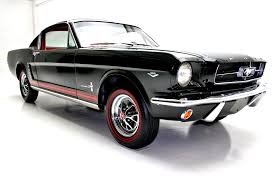
Today, 2,500 dollar bills will only buy you an old, high-mileage Mustang (if you’re lucky), while 2,500 silver dollars will buy you a brand-new, high-end Mustang, worth $40,000.

These are compelling reasons to add physical silver to your portfolio.
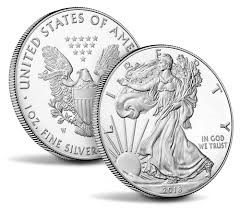
The American Eagle Silver Dollar
The American Eagle Silver Dollar is produced by the U.S. Mint as a non-circulating bullion coin. (A bullion coin is one that is valued primarily for its metal content.) It is legal tender, with a face value of $1, but its true value is based on its silver content, which is 1 oz. of pure silver.
A graded American Eagle is examined under magnification and if found to be without visible defect or flaw, it is given a perfect grade of MS70. It is then assigned a serial number and encased in hard-shell plastic to inhibit degradation.
Many other countries produce government-issued, 1-oz. silver coins, the more popular being the Canadian Maple Leaf, the Chinese Panda, the Austrian Philharmonic, and the British Britannia.
Commemorative silver coins feature unique tributes in honor of people, places and events and are also popular with both investors and collectors. These coins are often low mintage, which creates rarity and a potentially higher future value.
The Value of MS70 Silver Eagles
The value of a graded coin is the value of the silver, plus a premium based on its value as a collectible. The most newly minted ones are worth anywhere from around $50 to over $100, depending on what year they were minted, how many received the top grade, and who graded them. Some of the older ones are now worth several thousand dollars. So, these have value, not only to investors, but also to collectors.
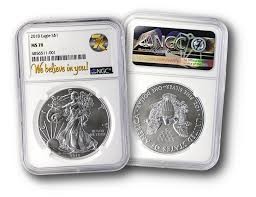
The MS70 Silver Eagle was first minted in 1986. Anyone who acquired one of these coins per month since then, would have almost 400 of them today. One estimate of the value of those coins is over $1 million.
Nobody knows if the next 30 years of collecting these will yield that kind of increase. As they say, “Past performance does not predict future results.” Of course, future results could even be better!
Important reasons to consider joining us:
- To diversify your portfolio – a way of protecting and insuring traditional investments.
- To accumulate a personal reserve of precious metals.
The Advantages of Membership
It is almost always the case that there is strength in numbers, and that is certainly true with membership in the Comstock Silver Network.
Our members are from many different places, but we are a network of like-minded individuals – part of a support system where there is a building of trust. And that creates opportunities for collaboration and cooperation.
Membership does have its advantages.

The Bottom Line
If you agree that precious metals are valuable to own … and that silver out-shines all the other precious metals, then we would encourage you to join us.